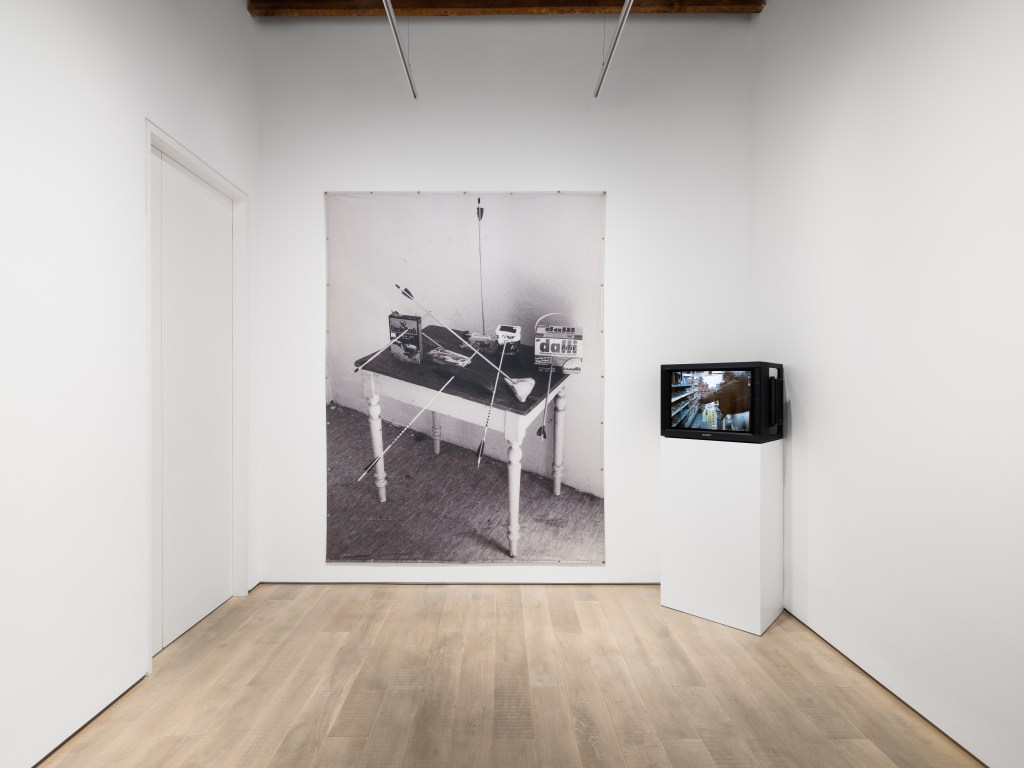
Die Jagd / The Hunt (1992) 20.07.24 – 12.10.24
Category: Senza categoria

Fiasco, Copia Originala, Bucharest, Romania
Heavy Weight History (2013) 11.07.24 -13.07.24
Backstage Engelberg, Engelberg, Switzerland
Luftschloss Engelberg (2024) 22.06. – 18.08.2024

Preis der Nationalgalerie 2024, Hamburger Bahnhof, Berlin
Congratulations (2000) 07.06.24 – 05.01.25

Living Sculptures, Skulpturenpark Schlossgut Schwante
Living Sculptures (2007) + Weather Flag (2019) 01.06.24 – 13.10.24
The models for Christian Jankowski’s “Living Sculptures” (2007) are street artists who are part of the city’s tourist attractions as living statues on Barcelona’s Las Ramblas. As much as these street artists are part of an urban culture and represent it through characteristic personalities, this relationship can also be alienated by the choice of characters. Unlike monuments, these artists are economically dependent on their daily audience. Jankowski’s selection makes this ambivalence visible: three depictions – Che Guevara, Julius Caesar and a figure from Salvador Dalí’s “Anthropomorphic Chest of Drawers”. The artist made life-size bronze casts of the sculptural figures and initially placed them in the places where he originally encountered them, before moving the sculptures to other locations, such as the Skulpturenpark Schwante.
“Whenever the wind is favorable”, Christian Jankowski instructed his gallerist José Garcia, he should send messages. In the course of an exhibition, Jankowski instructed the gallery to send letters written by him to curators, directors and other high-ranking figures in the art world with whom he had worked during his artistic career. Letters that he “always wanted to write but never did” were to be sent in his name when the wind was favorable. Jankowski takes up this idea again in his work “Weather Flag”, which was commissioned by curator Miguel Von Hafe Pérez in 2019. The flag features Jankowski himself, clutched tightly to the curator’s feet. Borrowed from Harold Lloyd’s iconic film scene, in which the US silent film actor hangs from the hand of an oversized clock, Jankowski’s “Weather Flag” refers to the dependency that exists between institutions and artists in the art world and places this in a metaphor of weather-related conditions: Thunderstorm! The wind is favorable! The mood has changed, the wind has shifted, the storm on the Bastille.

Antikstübchen Nachwort, Villa Schöningen, Potsdam
Antikstübchen Nachwort (2024) 05.05.24 – 18.08.24
An exhibition in honor of the Hamburg art collector Harald Falckenberg (1943–2023)
The life of every person inevitably leaves a mark. This is particularly true in the case of Harald Falckenberg, the Hamburg entrepreneur and lawyer. He left behind an unparalleled art collection of around 2,400 works with an emphasis on German and American contemporary art from the 1980s onwards. Anarchic, polemical and provocative works from the worlds of Fluxus and Neo-Dada. Conceptual and performance art, narrative, cynical, melancholic and humorous art, true to Falckenberg’s motto of “civil disobedience.”
As an excerpt from this collection, forty-five works by twenty-nine international artists are presented on loan from the Deichtorhallen Hamburg/Falckenberg Collection. This is complemented by a new expansive installation by the artist Christian Jankowski that pays homage to Harald Falckenberg as a collector and person. The work Antikstübchen Nachwort reflects Falckenberg’s physical and intellectual legacy.
The artist commissioned Rümpelwelt (https://www.ruempelwelt.de), a household clearance company, to transport the remaining objects to be cleared from Harald and Larissa Falckenberg’s apartment in Hamburg to Potsdam. Rümpelwelt then sorted the objects according to their future destination—used bookstore, donations, recycling center, and so on—and arranged them in the exhibition space. Light boxes complement these groups of objects and echo the aesthetic and style of junk stores. Advertising slogans are interwoven with Falckenberg’s text headings.
The accompanying video work documents the objects’ journey, focusing on the narratives and subjective experiences of the junk dealers. In an additional narrative thread, fragments from Falckenberg’s writings on art are recited by the junk dealers, who transcend their professional identity by assuming the role of the art collector. The result is a surreal moment. Falckenberg’s philosophy of collecting, his attitude to art and his humor are all continued in Jankowski’s artistic “afterword.”
An afterword is an aid to understanding, a reflection or a dedication at the end of a literary or rhetorical work. In the case of this exhibition, it comes at the end of a life whose traces will continue to have an impact on the present and the future for a long time to come.
Sonia González

Luftschloss Untergrund. Tag der Arbeit, Hermannplatz U-Bahnstation, Berlin
Luftschloss Untergrund from the series Luftschloss Royal (Castle in the Air) (2022) 01.05.24 – 01.06.24
For Luftschloss Untergrund, Jankowski reflects on the impracticable dream of the Humboldt Forum, which reached into the past to create a new cultural institution for Germany. As a partial rebuilding of the Berliner Schloss, a Baroque palace that was originally home to Prussian kings, it has become an accidental monument to the layers of trauma that permeate the city.
The palace was damaged by bombs during the Second World War. Its remains were destroyed by the German Democratic Republic, then in the 1970s the Palast der Republik was built in its place, which was demolished upon reunification. What would a castle for the twenty-first century look like? In the decades of debate between architects, planners, politicians, and historians, some felt left out.
A little way down Unter den Linden, Jankowski asked the construction crew working on the new Château Royal hotel, also a partial reconstruction of a historic building, to take a break and draw an imaginary castle. They made their drawings on architectural plans found on site: colourful marks appear over coffee stains and technical outlines of plumbing and electrical systems. Of these, one was realized as a neon sculpture. Installed on a balcony overlooking the hotel’s internal courtyard, at night it seems to float, opening a dialogue with the surrounding cityscape. Enlarged and illuminated, Jankowski’s treatment of the untrained sketch refers to the glorification of the working class in the time of the erased Palast der Republik. Additionally, he addresses the class system within architecture through the payment terms for each participant: they were paid for their time according to their usual hourly rate, but whenever a castle is acquired as an artwork, the sketcher receives a percentage of the sale, much like an architect’s fee.
The show opens on the International Worker’s Day. Symbolically aligning with the meaning of the work, the 1st of May commemorates the struggles and gains made by the labour movement.
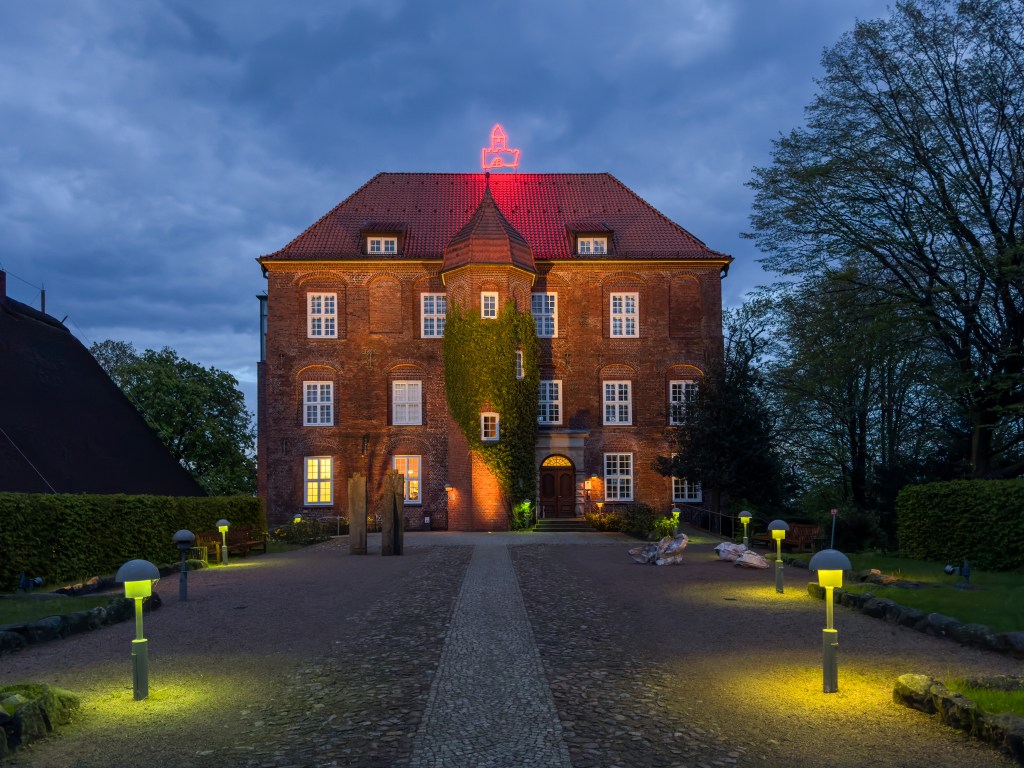
Luftschlösser. Die Kunst der Andeutung, Kulturstiftung Schloss Agathenburg, Agathenburg
Luftschloss Windschief + Luftschloss Luftbrücke from the series Luftschloss Royal (Castle in the Air) (2022) 28.04.24 – 23.06.24

Kopfüber in die Kunst. Vom Environment zur Immersion, Museum Ostwall, Dortmunder U
Sportstunde (2024) + Rooftop Routine (2007) + Hooping Guggenheim (2022) 22.04.24 – 25.08.24

Hello Lübeck. Dialoge mit der Kunsthalle St. Annen, Kunsthalle St. Annen, Lübeck
Geknetete Stadt (2023) + Smell Manouver (2023) 11.04.24 – 11.07.24
 Christian Jankowski